

Understanding paperboard properties
Paperboard is a natural material with many applications. As a print medium, paperboard can withstand the strains and stresses associated with the use of advanced finishing techniques. Paperboard is also highly durable, ensuring that printed materials will last for a long time. Typical graphical applications are book covers, cards, and CD and DVD covers. Paperboard packaging is a competitive method for transporting products from manufacturers to consumers, while also being easy to recycle.
A versatile and safe material
Paperboard’s excellent printing properties give brand owners great freedom to express their brand’s individuality and attract the consumer’s attention. Compared with other materials, paperboard made of fresh fibres offers high performance and relatively low weight. It is safe for consumers to use because it contains known substances and is made in the same way every time. All paperboard products manufactured by Holmen conform to relevant legislation and follow applicable product safety recommendations.
Efficient across the supply chain
Paperboard packaging often remains folded or flat until the products are packed. Thanks to its compact volume and low weight, significant energy savings are achieved in the transportation chain. Paperboard cartons can be sized to maximise the use of loading pallets, which furthers substantial energy savings in the distribution chain. When paperboard cartons have served their purpose, they can be folded and compressed before being transported to a recycling station. At every step of the way, paperboard packaging saves more energy and has lower environmental impact than most other packaging solutions, making it an eco-friendly choice throughout the supply chain.
A renewable resource
Paperboard is made from timber, which is a renewable resource. Sunlight and water make the trees grow, while they also bind carbon dioxide and release the oxygen essential to life. The forest’s closed ecological loop provides us with the raw material for paperboard, while used cartons and printed matter play their own role in the recycling systems of a sustainable society.
Holmen’s paperboard product families
Invercote , Inverform and Incada make up Holmen’s three paperboard product families. Invercote and Inverform are solid bleached boards, and Incada is a folding box board. They serve a wide range of application areas, from graphical applications such as brochures and covers for books and CDs to packaging. Which of our product families is most suitable depends on the customer’s needs in each specific case.
 When creased correctly, paperboard can be folded and unfolded many times without cracking.
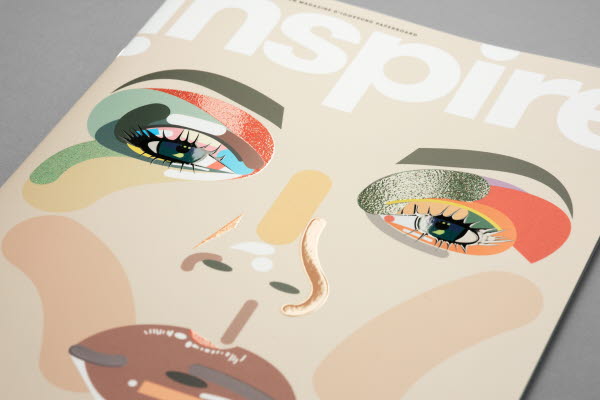
Varnishing can add an extra lustre to the printed surface.
Traditions in manufacturing
Holmen manufactures a range of paperboard products at Iggesund Mill in Sweden and Workington in England, as well as plastic extrusions and laminations for paperboard at Strömsbruk in Sweden. These facilities have been paperboard production units for the better part of a century, thereby helping to advance the craft, skill and tradition of sustainable paperboard manufacturing.
Responsible production practices
Packaging materials and the processes behind them are subject to increasing environmental scrutiny. As a paperboard supplier, Holmen takes responsibility for the environmental impact of its products, from sourcing raw materials to manufacturing and distribution.
Our approach to sustainability is built on long-term thinking, responsible forest management, and continuous improvement in energy and resource efficiency. We ensure that our products are safe to handle and use, and that our operations meet environmental requirements with good margins.
You can learn more about our sustainability commitments and certifications here.
Environmental impact
Sustainable forest management ensures both continued access to raw materials and the preservation of biodiversity. Packaging waste and landfill issues are a growing concern. Paperboard has long been easy to recover, either as recycled fibre or for energy recovery.
Holmen’s energy use is based on biofuels, and we continue to reduce our dependence on fossil fuels to lower carbon emissions. Compared to fossil-based packaging, paperboard has a lower carbon footprint. Its raw material, timber, is harvested from managed forests that absorb carbon dioxide and release oxygen.