

The forest
The forest is an invaluable resource that binds carbon dioxide and provides a renewable alternative to fossil materials. Young, growing trees bind more carbon than old trees whose growth has slowed. Through active and sustainable forestry, we increase our forests' capacity to absorb carbon dioxide.
Paper and paperboard are products derived from the forest, but trees are not harvested for the purpose of making them. We grow houses, manage the forest for the future, and from the by-products we make paper and packaging products.
Wood as a material
Wood is the only construction material that is entirely renewable, organic, and has a low climate impact. When trees grow, they bind carbon dioxide, which can then be stored in wood products and buildings for years and years to come. Fossil-based materials such as concrete and steel can be substituted.
Efficient use of resources
Holmen harvests the trees when they are fully grown. The tree trunks are used for sawn timber and converted into wood products. The parts of the log that can't be used for wood products, and small trees from thinnings, become paper and paperboard.
We manage the forest with a long-term perspective, balancing ecosystem functions and safeguarding biodiversity and resilience. Every time we harvest a tree, we plant new ones to ensure continuous growth.
Circularity in our production
Responsible use of resources is essential. When we refine wood, we get additional by-products such as bark, dry wood shavings and sawdust. These become bioenergy used in our operations or sold for electricity and district heating.
Another residual product from our paper and paperboard production is fibre sludge. We collect it during water cleaning, then use it for heat or compost it for soil reinforcement.
Technology for optimal use
The logs processed in Holmen's sawmills are scanned using advanced wood grading technology to ensure high quality and optimal use of each log. They are sawn into planks and boards, and can also be further processed into construction components, cross-laminated timber or tailor-made glulam beams.
Tree trunks are round, while wood products are most often rectangular. Additionally, trees have branches, knots, and bark. These leftover parts are put to good use. Holmen’s integrated business areas enable us to use 100 per cent of the raw material.
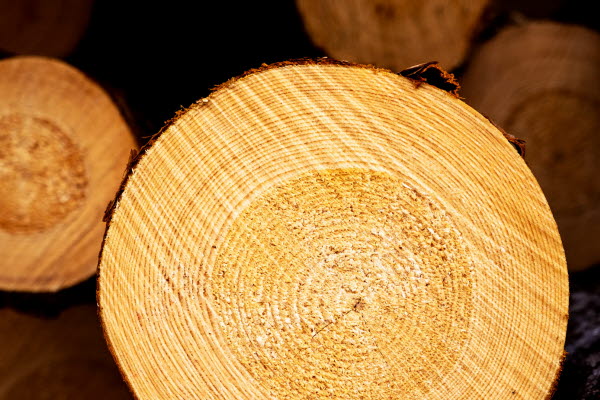
How we preserve the benefits of the fresh fibre
Handling the incoming material with care is essential to a sustainable process. Some logs and log parts are too thin or unfit for sawn goods. They are debarked and turned into wood chips, which are also collected from sawmills as raw material for paper and paperboard.
The wood is cut into chips, screened, and stored in silos before being refined to reduce sunlight exposure. This enhances the natural brightness of our products and reduces the need for bleaching. Quality controls are in place at every step.
High-quality fibre for sustainable products
In the pulping process, fresh fibres are separated without losing strength and elasticity. The quality of fresh wood fibres enables our paper to be thicker yet lightweight, a property known as bulk.
Our products are used for everything from packaging and transport solutions to books, magazines, advertising and notebooks. Their properties often allow for lower basis weights, which means less material is used and CO₂ emissions are reduced.
Wood chips from sawmills are ideal for producing high-quality fresh-fibre pulp. In Holmen’s thermo-mechanical process (TMP), fibres retain elasticity and form a strong but airy structure. Their bushy surface helps them bond, creating durable and lightweight products.